 I haven’t written about a film in a while, and this weekend I was inspired to finally write about this film, called Chuck and Buck. Somehow, it suddenly made my way back into my head over this past weekend; it is a film I saw a couple years back with a former partner of mine, at the MOMA. Iy is in fact a “gay” film (sort of), or rather, it will be seen as such in the eyes of many, should you choose to ever watch it. As I think of it, and I think it struck me then, too, it was interesting to watch a movie IN NYC, that was made in 2000, prior to 9/11, let alone an art house “gay” film.
In this review, I seek to point out some flaws in the way we as humans tend to want to condense things. The film revolves around Buck, who is most likely a person somewhere on the autistic spectrum. Sadly, if you read other reviews of the film, he is referred to as a “man-child”, which does not give the character justice, and which I cannot stand. He is childlike, but also rather indifferent, which takes away from some qualities of that which is childlike. Then, there is Chuck, now Charlie, his best friend from childhood. Throughout the film, we are not quite given the full picture of either character’s backgrounds, other than they were super tight, and… you can probably begin deducing already. Both men are in their 20s. Now, pay attention, because some of what I just said will tie in with another post I shall be writing later.
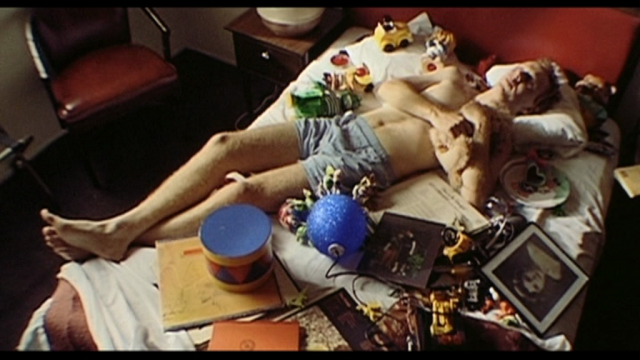
At the start of the film, childlike Buck, about 27 and living with his sickly mother, discovers her dead in one of the rooms of the house. This jumpstarts the whole “Chuck effect”, him being back in the picture, when he flies back to their childhood town for the funeral, and the 2 former besties reunite for the first time, after Chuck had moved away when they were still youth. Almost from the start, it is evident that Buck pines for, and always has, for Chuck (Charlie). Charlie has a fiance and a new life in California, however. It quickly becomes obvious, that as children, they engaged in activity of romantic and sexual nature. And THIS is where I really want to jump in and get away from the film itself.
As human beings, we tend to want to label, box everything in, etc. How many times have I spoken of this? What this movie brings to light, is how you cannot really flat out label someone fully as gay, bisexual, what have you, simply for certain ways they have lived, things they have done. Charlie was the older, slightly dominant one. You can tell, that Buck, poor Buck, was the highly sensitive, malleable, and vulnerable child, probably dominated by his mother, the mama’s boy. When Buck are Charlie finally confront each other, after loooong and looming avoidance of their childhood past, it becomes evident that Charlie, being older, instigated their sexual activity together as little boys. There are many things sad here. Sadly, many people do not seem to get the concept of love-deprivation, and there are many factors at play in this movie, bringing things to light, whether that was the writer’s (who plays Buck by the way) intention or not. Charlie, was probably a completely love-starved boy, whose parents didn’t pay much attention to him, OR, may have just been a more selfish creature (also due to love-deprivation), but spoiled, and of course, deep down inside, as we all do, felt unloved. And I feel, that this is why he would have chosen Buck as his closest friend. If you picture the character of Buck as a child, thinking already that he is sweet as an adult, you’ll probably think: blonde, sweet, soft, etc… And he, being this way, and having the older Charlie in his presence, most likely subconsciously tried to escape the suffocating effects of his mother/ parents, etc. So, he looked up to Charlie in more ways than one: he was an escape, and on top of that, coming from Buck’s end, thinking of what he had in terms of family at home, was even just a PHYSICALLY comforting presence for Buck. So for both characters, being male and best friends, there is also this distorted vision of one another, when it comes to comfort. I am in no way stating that homosexual behavior is wrong; what I am stating is, both children’s need for it and actually engaging in it as children, is rather distorted and leaves me with a sadness. The greatest sadness here, is that Charlie does not wish to acknowledge what he has been in Buck (who continues to look up to him and pine for him, even in adulthood)’s life. Resolution and some sort of peace come when the 2 finally make love as adults, but Charlie refuses to stay with Buck the night.
In the person of Buck, one does not know fully who, what and where he is. We do not know fully what he is molded into. All we see in the film, is his longing for Charlie. And Charlie, is either, gay, bi, or neither. Perhaps he simply needed affirmation as a child, and this is how it occurred. The same goes for Buck. Buck still yearns for him, but we never really know if Charlie is just cold and cruel, (selfish as I mentioned earlier on), and is more content to make money and live a life that “looks” normal. After seeing the film, I always felt that Buck was merely blinded by Charlie, and had nothing but Chuck in his eyes. There really is no way of concluding if Buck himself is gay, or if he just has had a life-long fixation with this one person, who happens to be male, and does not understand, and feel fully, what love is, what the sexual experience and attraction is for, meant for, and about. How sad to not know what love is, it’s true nature, and to “love” and chase someone, who shows no signs of knowing it themselves.
Another film I wish to review later is Mosquita and Mari. Stay tuned.
 thepunkorganist