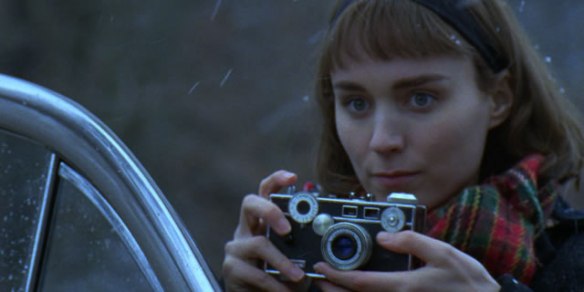
 I will say that last night I had the privilege of seeing the movie, Carol; I call it a privilege because of the fact that it is one of very few queer-geared movies out there that does not end in overly dramatic, does not involve, heart-breaking/wrenching, depressing tragedy. It was a film of beautiful cinematography, sincere wanting and longing, and just… I’ll say it again: nice film stills to look at!
While lacking in the overly dramatic, it did have that, but in a different way. I admit that throughout the film I found myself laughing at points that might seem inappropriate, and that was a lot of points! But, therein lies the intrigue. What first set off the giggles in me was seeing the main character Carol, played by Cate Blanchett, being so overtly flirty in the department store where her “eventual” interest works. It was so in your face that you would be quite dense to not know this woman was flirting with you! Cate Blanchett, remembering her regal portayals of Queen Elizabeth I, was transformed into a slightly swollen, somewhat mannish and stern housewife; it was quite interesting to see her in this light, and I certainly was not used to it. So, I suppose what I’m getting at is the degree of melodrama in the flirtation. Now, what is also interesting is the degree of juxtaposition in the film. While her flirting with the other main character, Therese, played charmingly and refreshingly sweetly/innocently by Rooney Mara, was so overdone, what was quite fascinating was that the movie draaaaaaaged out the climax of their union, the two characters coming together in love. It is true that these two barely had a real conversation before falling in love, but I suppose that’s left to us to decipher, through “who knows what they talked about in their incessant car rides across the country?”. My friends and I discussed all this last night afterwards; it was great fun.
The other interesting aspect was, when they first met, the mousy Therese in the department store, trying to help Carol pick out a Christmas present for her 4-year old daughter, tells Carol that as a 4-year old girl, she wanted a train set. I was unsure whether this was a jab at stereotyping, trying to show “oh of course one of the partners has to have ‘boyish tendencies'”, or if it really was just trying to break down a gender stereotype.
A moment that really stuck out to me, was that when Carol and Therese could no longer maintain contact for a period of time, Therese called her once from her poorly flat, trying in vain to reach her; Carol answers but hangs up, and you can’t help but FEEL as Therese says into the phone repeatedly after being hung up on “Carol, I miss you. I miss you. I miss you.”. In that scene, I knew that Carol was the perfect name for this character. Somehow, that name just jumped out, stood out to me tremendously! This aside, the phone call was a certain show of the beautiful sincerity of the film. Another scene which showcased this, short as it was, was on Therese’s drive back home to New York City, she has to get out of the car at one point, and vomits. You know that she is entirely heart-sick, from the letter of good-bye that Carol sends to her, as she has by this point returned home to fight for custody of her daughter.
This movie was sewn together beautifully: each scene sewn together sweetly, through thoughtfully written music for the film, and again, the cinematography, along with scenes and events I described above. It is true, that the movie deflects the realities of the hardships these women REALLY would have faced during the time period in which it was set, but I think its purpose was simply to portray love, and perhaps did not set out to be a straightforward LGBT type of film. Yes, I laughed at many scenes; they first get in contact because Carol happens to leave her gloves on the counter in the department store, and Therese, immediately and confusingly taken with Carol, steadfastly makes sure to mail them to her. For the ending, I joked that perhaps Therese went to meet her at that party after all, because Carol simply left her gloves behind once again. But, no joke, this movie is dope! The closer you get to something that is troubling and different from you, the more empathy you will feel for the people who struggle. I so enjoyed its ending, open to interpretation, but you pretty much are secured in the direction for which things will go for the characters. Beautiful and truly moving. Did I mention this movie is dope? 🙂
And now an addendum… I confess I just returned from seeing the movie a second time. What I forgot to mention initially is the very first opening scene of the film; you see at first something that appears to be a gate/bars/grill, something very trapping in style; in my eyes, a toss at the very premise of the movie: that this is about a gay couple and they are not free. It’s quite interesting what you come back with when you view something a second time, isn’t it? I’m not someone who watches a lot of movies, so for me to have viewed it twice, says something. What I came back with was sadness over the very concept of the actor. Often, roles are just toss-away, unimportant, and stupid roles. However, sometimes, there’s a role that is sweet and innocent, pure of heart, intelligent, etc. And I thought, how sad, because I saw Rooney Mara at the Gold Globes last night, and I thought, if only she could learn from the character she portrayed; if only a little bit of that innocence rubbed off on her. But, sadly, what I noticed is that the artistry of the actor is incomplete; they merely take on a role, learn its parts, and then toss it away when the film is finished. How sad is this? I will also say, that Therese, in saying “Yes” to everything all the time, really reveals how, when a person is that way, in many respects you can’t trust them; their desires are wishy washy, when someone merely says yes to everything.
The movie even triumphed over the book. In the book, when Therese asks, “Isn’t it better than sleeping with a man?”, sadly, book Carol replies, “Not necessarily…”. That’s a real let down and I wonder if such lines might be used by women who are bisexual to “get back” at gay women in some way. Movie Carol is a triumph over book Carol; in the movie, the characters are truly gay, truly just long to be with a woman and have been trapped, lost, however you want to put it, all their lives. I appreciate too, that the movie did this; usually one does not prefer deviations from the original story, but given the topic, I think it can certainly be applauded for certain reasons. Also, in the book, Carol is only about 10 years older than Therese, and has a daughter about 8 years old, making her to have had a child at around the age of 22. Carols speaks of her married life with summers spent in Italy and France, etc, as though this all were some great compliment. Again, another thing to be glad about, that this movie “came out” and made movie Carol who she is: a bit softer, gentler, more thoughtful. Still, the fact that Therese is named Therese, gives me hope for the book, in spite of the “erroneous” nature of the author I’ll refer to it as, for Therese was the patron saint of the elementary school I attended.
I suppose this is has become a small juxtaposition of the movie versus the book. I am not a great fan of film in general, which is why this movie has conjured up so many thoughts. Although I am gay, the book made me question the depth of same-sex love. In the book, when Carol leaves Therese to return to New York to fight for custody of her daughter Rindy, the book seems to frame everything as very linear: that Carol has said she promised to not see Therese anymore, because clearly, she loves her daughter more than she loves Therese. You start to believe that to be true, and think that is the author’s absolute sentiment, and that there is no way around it. If you’re a gay person, who was once in a heterosexual relationship that bore a child, and you now had a same-sex partner you were deeply in love with, but were threatened with never seeing your child again because of it, what would you do? Indeed, the book shows us that there is in fact a way around it; Carol DID love Therese truly, both she and her daughter equally. She simply gave up fighting in court; she was courageous, did what she had to do in order to remain with Therese, in a way that still enabled her to see her daughter, though much less frequently. Book Carol IS indeed brave. In the movie however, Carol’s love for Therese is really never questioned, is direct, and the “actions” merely have to be put on hold for a while.
All in all, still a dope film and story.

 thepunkorganist