Wow, they blew me away again! Once again, Star Trek has disarmed me, maybe even blown me away. As though the Deep Space Nine episode Rejoined wasn’t enough, Star Trek The Next Generation brings us the episode called “The Outcast”, based on the J’naii people. They are a world of androgynous persons, in which it is a CRIME to be treated medically if you find yourself to identify with a gender. Ring a few bells? Well, it certainly touches upon many topics, and brings many thoughts. For the people who DO feel they are a particular gender, is it possible in their world to be born biologically a certain gender, but on top of that, as we earthlings have here, find yourself to identify with the gender you are not biologically? It is explained that at one time, their culture had 2 genders, but they “evolved”, and gender ceased to exist. Clearly, these people ARE born with particular sexual organs, but they make each person neither a he or a she. The episode certainly has its shortcomings. The main J’naii character, Soren, reveals that she identifies as female, and is attracted to males. So, sadly, most likely, if someone as myself came along, and told her that as a human I was born biologically female but am male in many ways, she would still most likely reject me. So, the storyline, in trying to be progressive, still falls short, but you must forgive it, given the era it was born of. In the end, after falling in love with Commander Riker, she is “treated”, and the episode ends with all her life struggles having meant nothing to her; the struggle to hide who she was, etc. She simply says, “I was wrong. I can’t believe I ever felt those things.”. You see, when you have a certain inclination, and then have a different one, you simply are who you are; you don’t want anything else other than what you desire at that time. You can switch back and forth a million times, and always want only what THAT way of being that you are in a given time, wants. At least on their planet, “treatment” seems to “work”. For people who know me who don’t understand my inclination towards a “(supposedly) male name and pronouns, in this epsiode, Dr Beverly Crusher states, when questioned by the androgynous Soren as to what it is like to be female, “It’s just the way I am; I’ve never really thought about what being female means.”. You see, a person such as myself on the other hand, is hyper aware of gender, gender roles and the consequences of being a specific gender, etc. As the person I am, I wish to bring to media, television, movies, the truth of persons like myself, biologically female for example, telling a burdened, hiding judged gender-identifying character like Soren, that she too would reject me. I wish to bring characters like this to life. Thanks again, S
Category Archives: reviews
Soviet Cartoons. The Weight A Creator Bears
At the end of this post, I will post links to view each of the cartoons mentioned here.
I could write this better perhaps, but it’s something that’s been on my mind as I’ve recently come to know someone from Russia, someone who grew up in the USSR, and that same person, a person abused as a child, as many of us have been. As I write this, in fact a bit of European lace curtain sits before me.
The thought is of a cartoon and how a cartoon can bear the weight, hopes, dreams, and disorder of a nation, its culture, its people. I recently came to be exposed to 2 Russian cartoons: the Russian version of Winnie the Pooh, and a lovely, endearing, and sweet small creature named Cheburashka. I quickly came to learn that during Soviet times, they did not produce long-running series, so rather, these 2 cartoons for example, consisted of a couple full-length movies that were cup into a few episodes each. I won’t lie; that was a total BUMMER when I realized I had so quickly seen every episode already.
Yet, what lasting, captivating effect each of these cartoons had, in both their opening and closing sequences, and interspersed throughout each episode. I speak of the music, the aesthetic presented in the cartoons, and the cultivation of the characters. I suspect the same to be true of many European cartoons in general. So much more ARTFUL. Those who know me know how I ADORE Peanuts and Snoopy, and the music was a refreshing glint, but still, what was it but jazz. And, you can use jazz anywhere in the world. It’s the lack of fear to steep these cartoons with their own culture through music, again for instance, heavily, and beautifully, into something seemingly as simple as a cartoon, for children to take in, soak up. And, if you could just take the time to watch an episode of Cheburashka, you would see pop-out whimsical trees amongst the rather cutting-edge (for the Soviet Union) puppetry, much like a dreamy drawing for sale on Etsy.
Soviet Winnie is a very different character from we’re used to. His voice is unpleasant, but he’s kind- but at times slightly conniving, along with Owl. Winnie is eager to visit a “friend”, merely to eat and overstay his welcome. Not hesitating to use a friend’s only balloon to try to float to the top of a tree to obtain honey, as well. And, the WAY he looks and HOW he climbs trees, are just golden. The commentary made by each character is just charming, even in their somewhat chaotic and childish world. What really cuts through in this cartoon to communicate the weight and sadness of the Russian people, in addition to the music used, is the character of Eeyore. If you thought he was depressed, never before have I seen so sorrowful a presentation of the character, one whose view purely glooms. He makes me to cry, in fact.
Let’s talk about Cheburashka, a sweet monkey-like creature discovered sleeping in a crate of oranges that had arrived at some fruit stand in the Soviet Union. While Eeyore, you want to comfort and heal because he is so heavy and you can’t help but immediately think of the hurting Soviet child, as it is a children’s show, Cheburashka is sadness due to effective and affective creation of an entirely childlike character, so untainted by the world, but realizing he does not fit in. Quickly however, we learn that none of his cast-mates really do, and STARVE for companionship. How evident this is, before Cheburashka meets his soon-to-be best friend Gena the crocodile (who “works” as a crocodile in the zoo), in the scene in which he finishes his day’s work, redresses in his distinguished attire, and heads home to play chess with himself, and to “smoke” his pipe, which he uses to produce soap bubbles. He soon pens an ad reading, “Young crocodile seeks friends…”; how moving to the soul, and how as humans, we all relate to this at some level, is this not?
The facial expressions alone of this claymation/puppet show, without words, to me, can speak it all. It seems to me, in their brief run, the creators of each of these cartoons were brilliant, and it was their way of expressing their own sincere sorrow, both by nature given their culture, and of outside forces, their government. Cheburashka is the most sweet-voiced of creatures, and is akin to an orphaned child.
Of course, as I watch these shows or think on them, I think of the aforementioned person I have come to know. What effect then it shows me, that both these shows and this person have on me, given their roots, and the success these shows had in moving a heart. I struggle to reconcile these shows being a part of my friend’s childhood, with the abuse this person also endured in childhood, and it makes me to cry. The cartoons are locked in time, but their effect continues, and my friend is free.
If we look at almost anything, we see that humans have found a way to convey, to express, to free themselves, in the most secret and untouched of places. Looking into the little eyes of Cheburashka, and even of Gena, I see a whole people, and I see their sadness, yearning, and calling for affirmation.
Chuck & Buck
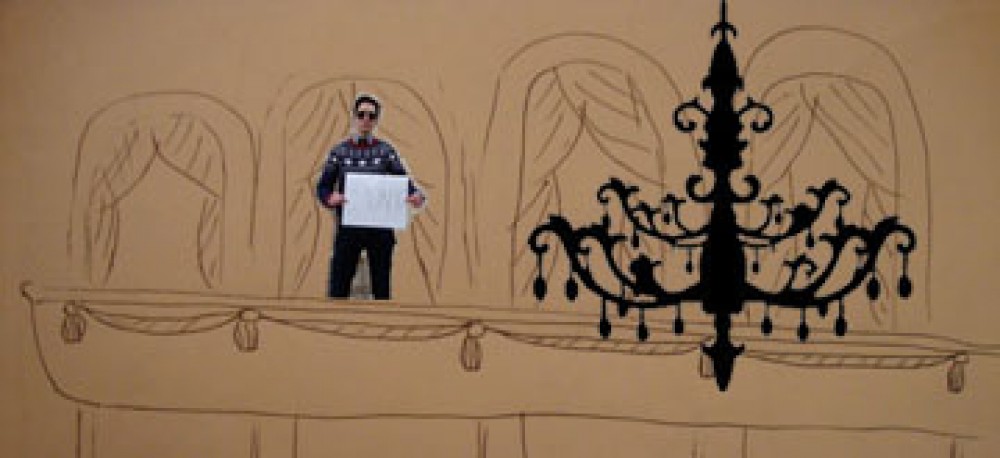
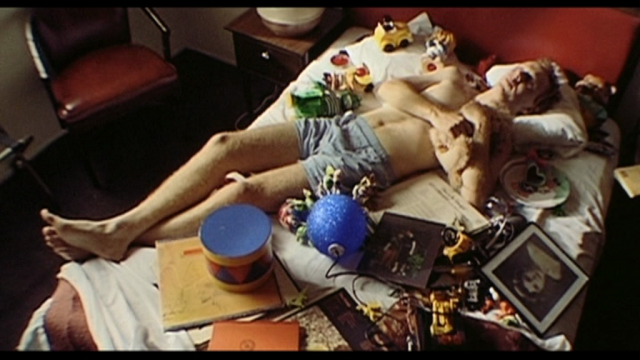
I haven’t written about a film in a while, and this weekend I was inspired to finally write about this film, called Chuck and Buck. Somehow, it suddenly made my way back into my head over this past weekend; it is a film I saw a couple years back with a former partner of mine, at the MOMA. Iy is in fact a “gay” film (sort of), or rather, it will be seen as such in the eyes of many, should you choose to ever watch it. As I think of it, and I think it struck me then, too, it was interesting to watch a movie IN NYC, that was made in 2000, prior to 9/11, let alone an art house “gay” film.
In this review, I seek to point out some flaws in the way we as humans tend to want to condense things. The film revolves around Buck, who is most likely a person somewhere on the autistic spectrum. Sadly, if you read other reviews of the film, he is referred to as a “man-child”, which does not give the character justice, and which I cannot stand. He is childlike, but also rather indifferent, which takes away from some qualities of that which is childlike. Then, there is Chuck, now Charlie, his best friend from childhood. Throughout the film, we are not quite given the full picture of either character’s backgrounds, other than they were super tight, and… you can probably begin deducing already. Both men are in their 20s. Now, pay attention, because some of what I just said will tie in with another post I shall be writing later.
At the start of the film, childlike Buck, about 27 and living with his sickly mother, discovers her dead in one of the rooms of the house. This jumpstarts the whole “Chuck effect”, him being back in the picture, when he flies back to their childhood town for the funeral, and the 2 former besties reunite for the first time, after Chuck had moved away when they were still youth. Almost from the start, it is evident that Buck pines for, and always has, for Chuck (Charlie). Charlie has a fiance and a new life in California, however. It quickly becomes obvious, that as children, they engaged in activity of romantic and sexual nature. And THIS is where I really want to jump in and get away from the film itself.
As human beings, we tend to want to label, box everything in, etc. How many times have I spoken of this? What this movie brings to light, is how you cannot really flat out label someone fully as gay, bisexual, what have you, simply for certain ways they have lived, things they have done. Charlie was the older, slightly dominant one. You can tell, that Buck, poor Buck, was the highly sensitive, malleable, and vulnerable child, probably dominated by his mother, the mama’s boy. When Buck are Charlie finally confront each other, after loooong and looming avoidance of their childhood past, it becomes evident that Charlie, being older, instigated their sexual activity together as little boys. There are many things sad here. Sadly, many people do not seem to get the concept of love-deprivation, and there are many factors at play in this movie, bringing things to light, whether that was the writer’s (who plays Buck by the way) intention or not. Charlie, was probably a completely love-starved boy, whose parents didn’t pay much attention to him, OR, may have just been a more selfish creature (also due to love-deprivation), but spoiled, and of course, deep down inside, as we all do, felt unloved. And I feel, that this is why he would have chosen Buck as his closest friend. If you picture the character of Buck as a child, thinking already that he is sweet as an adult, you’ll probably think: blonde, sweet, soft, etc… And he, being this way, and having the older Charlie in his presence, most likely subconsciously tried to escape the suffocating effects of his mother/ parents, etc. So, he looked up to Charlie in more ways than one: he was an escape, and on top of that, coming from Buck’s end, thinking of what he had in terms of family at home, was even just a PHYSICALLY comforting presence for Buck. So for both characters, being male and best friends, there is also this distorted vision of one another, when it comes to comfort. I am in no way stating that homosexual behavior is wrong; what I am stating is, both children’s need for it and actually engaging in it as children, is rather distorted and leaves me with a sadness. The greatest sadness here, is that Charlie does not wish to acknowledge what he has been in Buck (who continues to look up to him and pine for him, even in adulthood)’s life. Resolution and some sort of peace come when the 2 finally make love as adults, but Charlie refuses to stay with Buck the night.
In the person of Buck, one does not know fully who, what and where he is. We do not know fully what he is molded into. All we see in the film, is his longing for Charlie. And Charlie, is either, gay, bi, or neither. Perhaps he simply needed affirmation as a child, and this is how it occurred. The same goes for Buck. Buck still yearns for him, but we never really know if Charlie is just cold and cruel, (selfish as I mentioned earlier on), and is more content to make money and live a life that “looks” normal. After seeing the film, I always felt that Buck was merely blinded by Charlie, and had nothing but Chuck in his eyes. There really is no way of concluding if Buck himself is gay, or if he just has had a life-long fixation with this one person, who happens to be male, and does not understand, and feel fully, what love is, what the sexual experience and attraction is for, meant for, and about. How sad to not know what love is, it’s true nature, and to “love” and chase someone, who shows no signs of knowing it themselves.
Another film I wish to review later is Mosquita and Mari. Stay tuned.